

As a tattoo artist, I spend as much time thinking about how a design looks on the body as I do about the actual technique of applying the ink. A successful tattoo is more than just clean lines and solid color; it’s art that interacts with the human form. When we talk about tattooing the arm—whether it’s a full sleeve, a half-sleeve, or a standalone piece—we’re talking about the critical principles of flow and composition.
This isn’t about rigid rules; it’s about making the art feel completely cohesive and integrated with the anatomy.
The Challenge of the Cylinder
The first thing to understand about the arm is that it’s a three-dimensional cylinder. It’s constantly moving, rotating, bending, and flexing. A design drawn flat on paper will look distorted and awkward when wrapped around a curve.

Our goal is to compose the piece so that it looks coherent and stable from every perspective. We can’t just rely on a single, flattering photo angle.
- Defining the Structure with Negative Space: When designing a sleeve, it’s tempting to fill every millimeter with detail. But negative space—the bare skin—is essential. It provides visual relief for the eye and helps the main elements of the tattoo truly read. Strategic gaps and framing are necessary for defining the overall structure and separating major motifs.
- Creating Visual Continuity: The arm naturally hides parts of the design as it moves. We use this to our advantage by placing large, anchoring elements on the most visible planes, and then connecting them with continuous background work that carries the viewer’s eye around the curves and over the joints.
Flow: Guiding the Eye Across the Anatomy
Flow is the sense of movement and direction built into the tattoo. On the arm, flow must correspond to the natural lines and musculature. We want the design to integrate with the body, not sit awkwardly upon it.

- Following Anatomical Contours: We use the direction of the muscles and tendons as natural guidelines. For instance, elements in a sleeve often angle downward from the shoulder to the elbow, and then may transition to an opposing angle from the wrist towards the elbow. This natural directional shift helps the design feel dynamic and organic.
- Connecting Elements: Whether it’s the motion lines of water, the vines of a floral piece, or abstract shapes, these connecting elements are used to bridge the gaps between major motifs. They act as visual pathways, guiding the viewer’s focus seamlessly from the shoulder cap down to the forearm. A well-composed sleeve ensures the eye moves through the design without getting trapped in a static block.
- Managing the Joints: The elbow and the wrist are high-motion areas. We typically avoid placing high-detail focal points directly over these joints, as constant movement and wear can compromise the design’s clarity. Instead, we use elements like background fillers (smoke, clouds, texture) to smoothly bridge these transitional zones while maintaining the overall flow.
Composition: Establishing Focus and Balance
Composition is the arrangement of elements used to achieve balance, visual rhythm, and a clear focal point. Every impactful tattoo needs an anchor—a part of the design that immediately commands attention.
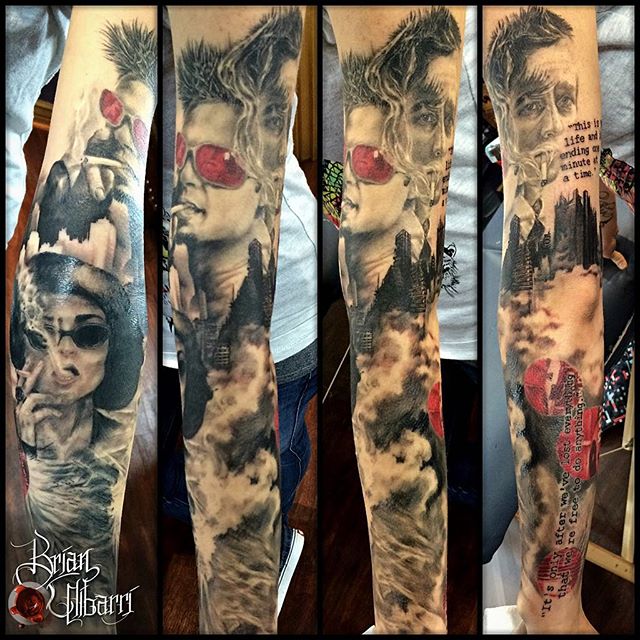
- Primary Placement: We position the largest, most detailed elements—the main motifs—on the major, flatter planes: the outer bicep and the outer forearm. These are the spots most clearly visible when the arm is at rest and offer the best “canvas” for detail.
- Scale and Contrast: We manipulate size and the level of light-to-dark contrast to create visual interest and depth. A bold, dark central object contrasted against lighter, textural background elements helps prevent the sleeve from becoming a visually flat collection of same-sized images.
- The Wrap-Around Read: Before the stencil is applied, we confirm how the design translates to the cylinder. We ensure that key visual information slightly overlaps and wraps around the curvature, suggesting the entire image even when only a section is visible. This is how we take a two-dimensional drawing and transform it into a fluid, three-dimensional work of art.
Ultimately, composing a tattoo on the arm is a meticulous process, balancing the art’s intent with the client’s anatomy. The final result is a piece that is not just aesthetically pleasing, but one that enhances the inherent structure and movement of the human body.
I am currently working at Real Gone Denver for appointments go to my scheduling process page and read up on how to submit your project.